

If your child has just entered Primary 6, the looming shadow of the PSLE likely feels closer than ever, especially with WA1 approaching. Many parents find themselves asking: “Did we start too late?” or “Is a significant grade jump still possible?”.
The honest answer is no, it is not too late. While language foundations take time to build, P6 is often the year where students see the most visible improvements—if they stop trying to do “everything” and start focusing on the right things.
The Strategy: Focus on High-Return Areas
Let’s be real for a moment.
Chinese is a language. You can’t magically fix everything in a few weeks. Some foundation gaps take time, and that’s just the reality.
Where many families struggle is this: once panic sets in, everything feels urgent. More tuition, more assessment books, more practice papers. The child becomes busy, but not necessarily better.
What works better in P6 is knowing where to put your energy. Not everything gives the same return.
What Actually Improves Well in P6
From working with many P6 students over the years, a few patterns are very clear.
First, vocabulary usage.
Not memorising long lists, but actually knowing how to use words properly in sentences. When vocabulary improves, a lot of things improve together — comprehension becomes clearer, oral answers sound less broken, and even composition feels less “stuck”.
Second, oral expression.
Oral is 25% of the PSLE Chinese score. That’s not small. For many students, it’s also the most “reachable” component. When students learn how to organise their thoughts and speak in complete sentences, confidence improves very quickly.
We’ve seen many students improve 1–2 AL bands by focusing on these areas. Last year, one P6 student even improved two AL bands after prelims, mainly by working on oral consistently, supported by vocabulary practice.
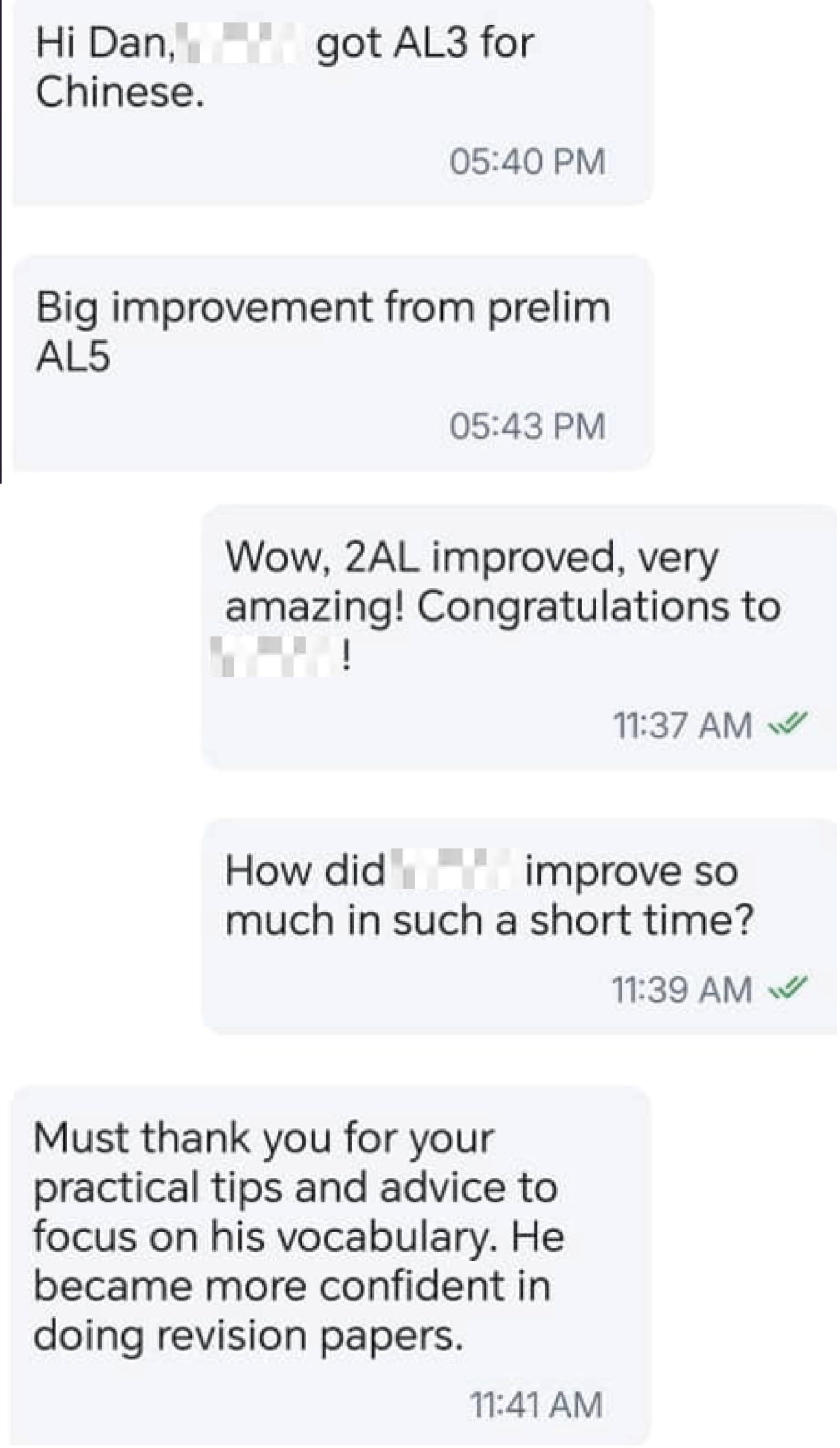
Not because the student suddenly became very strong in Chinese — but because effort was placed where it mattered most.
What Gets Harder If You Ignore It
At the same time, some things don’t go away on their own.
If a child has weak foundation vocabulary from earlier years, keeps guessing during comprehension, avoids speaking Chinese, or memorises answers without understanding, these issues tend to surface again later — usually around June or July.
That’s when parents start to feel the stress properly, because suddenly time feels very tight.
This is why clarity earlier in the year helps a lot.
A Realistic P6 PSLE Chinese Plan (From Now to Oral Season)
Instead of trying to do everything at once (and stressing everyone out), most P6 kids actually do better when preparation follows a simple rhythm. It keeps things calmer at home, and progress feels more real instead of rushed.
From now until around end-May, the focus should really be on fixing the basics. Before worrying about exam techniques, your child needs to feel comfortable with the Chinese they already know. A lot of PSLE Chinese — whether it’s comprehension or oral — comes from textbook language and everyday words. When this part is shaky, even easy questions can suddenly feel very hard.
This is why many parents spend this period helping their child slow down a bit: revising vocabulary properly, understanding how words are used in sentences, and reading passages aloud regularly. It’s not glamorous, but it works. Going from recognising words → seeing them in sentences → reading them in full passages helps things “stick” much better.
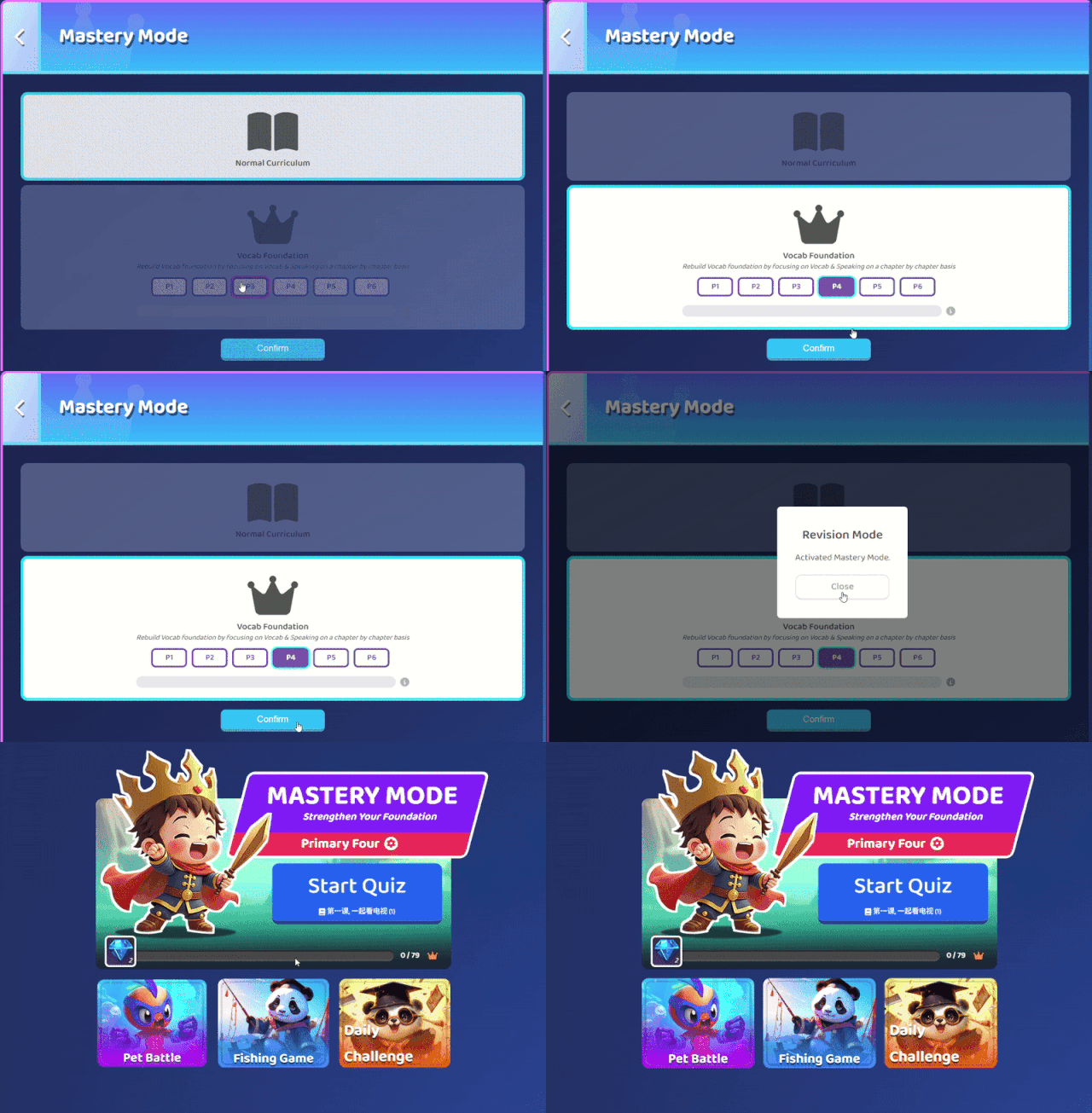
Some parents use tools like VocabKing during this phase because it makes daily practice more structured. The child can start from the right level, practise step by step, and close gaps without guessing what to do next. It also gives parents a bit more peace of mind, knowing earlier gaps aren’t being swept under the carpet.
Why This Also Helps Oral Later
Many parents only start worrying about oral when it’s close to the exam. But oral confidence doesn’t come overnight. It’s built earlier — through vocabulary clarity, structured thinking, and regular speaking. When these habits are already there, oral season feels much less scary. That’s why students who start earlier often go into oral exams calmer and more confident.
As we move closer to June, attention naturally shifts towards oral. Oral is 25% of the PSLE Chinese score, so it’s not something you want to leave to the last minute. From what we see, kids who start oral practice earlier tend to be a lot calmer when oral season comes around.
At this stage, regular speaking makes a big difference. Practising common topics, organising sentences properly, and learning how to explain ideas instead of memorising lines all help. Reading aloud also becomes very useful here — it improves pronunciation and flow, and at the same time reinforces vocabulary learned earlier. Having guided oral and read-aloud practice (like what some parents use VocabKing for) makes it easier to keep this going daily without nagging.
Then comes July and August, which is really about fine-tuning, not learning brand new things. This is when kids practise common oral question types, revise key vocabulary and sentence patterns, and try mock-style oral practices so the exam format doesn’t feel scary. Doing this in a low-pressure way helps reduce nerves and builds confidence.
Kids who reach this stage feeling steady — not panicked — usually perform much better than those who only start rushing when the exam is right in front of them.

“My Child Already Has Tuition…”
This is something we hear very often. Tuition helps many students, and for some families it’s an important support. It provides structure, guidance, and exam techniques that are useful, especially in P6.
At the same time, tuition classes have their limits. Lessons move at a fixed pace, time is limited, and teachers need to take the whole class forward. For students who didn’t fully grasp certain basics earlier, lessons can sometimes feel rushed — even if everyone is trying their best.

Why Home Practice is the Essential “Tuition Partner”
While tuition provides valuable exam techniques, classes often move at a fixed pace and may not address a child’s specific foundational gaps. This is why regular 15–20 minute daily practice at home is crucial. Tools like VocabKing can support this by allowing children to revisit earlier gaps at their own pace, making tuition lessons more effective and less stressful.
How Parents Can Tell If Progress Is Real
You don’t need to wait for exam results to know whether things are improving. You’ll usually see it in small day-to-day changes:
- Answering questions faster with fewer “I don’t know” responses.
- Sentences becoming longer, clearer, and containing less English-mixing.
- Reading aloud sounds smoother and more confident.
- Reduced resistance toward practicing the subject.
If you notice several of these, improvement is happening — even if marks haven’t caught up yet.
If none of these appear after some time, it usually means the way the child is practising needs to change, not that the child is lazy or incapable.
Final Thought
Improving PSLE Chinese in P6 is not about sheer volume; it is about doing the right things at the right time. By focusing on vocabulary application and oral communication through consistent, short bursts of practice, your child can walk into the exam hall with confidence rather than panic.
Try VocabKing NOW — 7-day free trial: https://learn.vocabking.com.sg/login or WhatsApp us at +65 8064 8461 for more info.
No responses yet