
As the June holidays come to an end and Term 3 begins, many Primary 6 parents start asking the same question:
“With only seven weeks left before PSLE Chinese Oral Exam 2026, what should my child be doing now?”
If you’re feeling a little anxious, you’re not alone.
The PSLE Chinese Oral Exam is often the first major paper in the PSLE calendar. Many parents worry that their child isn’t speaking confidently enough, doesn’t know enough vocabulary, or freezes when asked follow-up questions.
The good news?
Seven weeks is still enough time to make meaningful progress.
The key isn’t studying for longer hours. It’s focusing on the right skills at the right time.
Instead of trying to cover everything at once, think of these final weeks as four stages. Each stage has a different goal.
Your 7-Week PSLE Chinese Oral Roadmap
| Timeline | Focus | Goal |
|---|---|---|
| This Week | Assess your child’s current level | Identify strengths and weaknesses |
| Weeks 7–4 | Vocabulary, Reading Aloud & Speaking | Build strong foundations |
| Weeks 3–2 | Oral Conversation & Common Themes | Think like the examiner |
| Final Week | Mock practice & confidence | Be exam ready |
Don’t worry if your child isn’t where you’d like them to be today.
The purpose of this roadmap is to help you focus on what matters most, one step at a time.
Assess Your Child’s Current Oral Level (This Week)
Before planning revision, it’s important to know your child’s current starting point.
Many parents immediately buy more assessment books or search for predicted Oral topics. However, without understanding where your child is struggling, it’s difficult to know what to practise.
Set aside about 20 minutes one evening and let your child complete:
- One Reading Aloud practice
- One Oral Conversation question
Then observe quietly before giving any feedback.
Ask yourself:
✔ Can my child pronounce words clearly?
✔ Does my child read naturally with expression?
✔ Can my child speak continuously for about one minute?
✔ Does my child pause because they don’t know the vocabulary?
✔ Or do they know the words but struggle to organise their ideas?
These answers will help you prioritise the next few weeks.
💡 Parent Tip
Resist the urge to interrupt every mistake.
Many children simply need another three to five seconds to think before continuing. Giving them space to organise their thoughts often leads to much better answers.
If your child is already using VocabKing, this is a good time to try the E-Oral Mock Exam Practice. It provides instant AI feedback, making it easier to identify strengths and areas that need more attention before building a revision plan.
Build Strong Foundations (Weeks 7–4)
This is where the biggest improvements usually happen.
One mistake many parents make during this period is spending too much time looking for predicted Oral topics.
The reality is that no matter what topic appears during the examination, your child still needs the same core skills:
- A strong vocabulary
- Clear pronunciation
- The ability to express ideas confidently
Instead of worrying about what topic might appear, focus on how your child prepares.
A Simple Way to Think About PSLE Chinese Oral
Success in PSLE Chinese Oral isn’t just about speaking well.
It starts with three building blocks.
Know the Words
↓
Organise Your Thoughts
↓
Speak with Confidence
Many children don’t struggle because their Chinese is weak.
They struggle because one of these three building blocks is missing.
Over the next few weeks, your goal is to strengthen each of these areas step by step.
Let’s start with the first one.
1. Build Active Vocabulary
One comment we hear from parents every year is:
“My child understands the question but doesn’t know how to answer in Chinese.”
Most of the time, the issue isn’t confidence.
It’s active vocabulary.
There’s a big difference between recognising a word in a passage and recalling it instantly during a conversation.
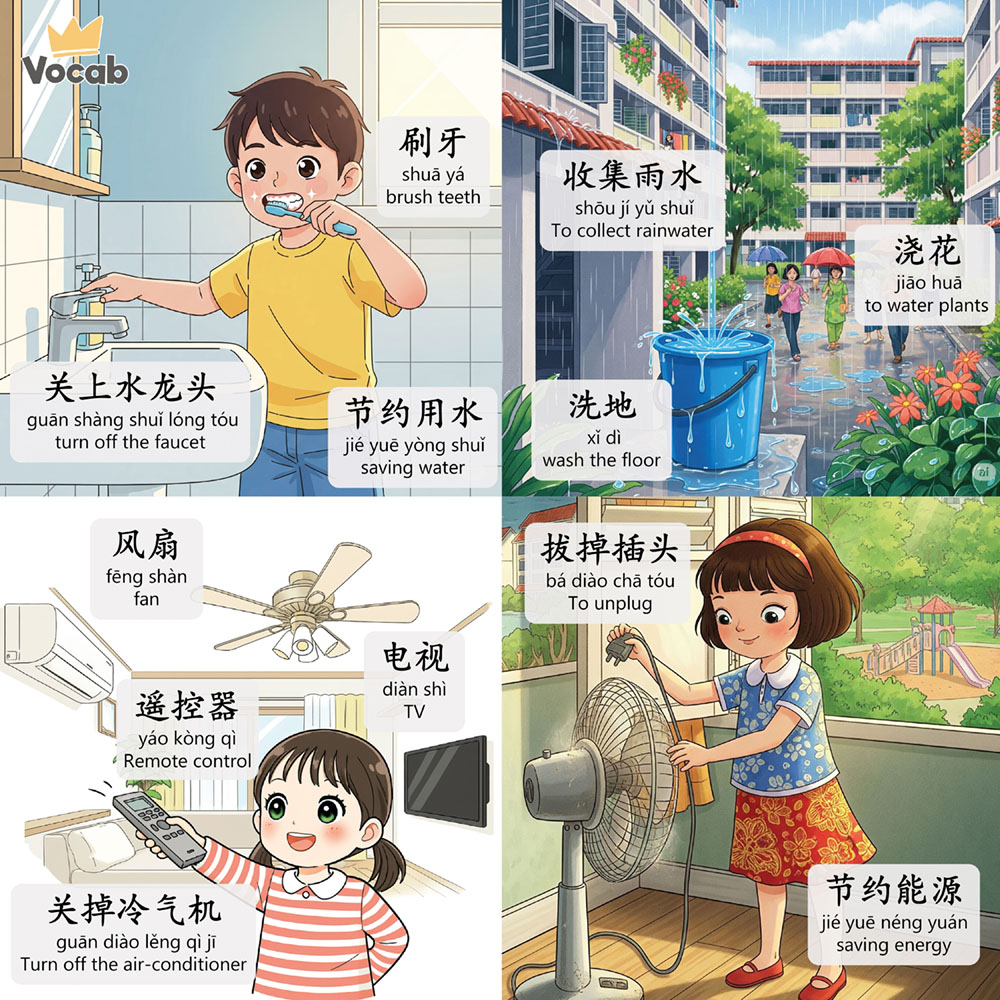
For example, can your child immediately name these everyday items in Chinese?
- 天桥 (overhead bridge)
- 小贩中心 (hawker centre)
- 托盘 (tray)
- 水龙头 (tap)
- 自动扶梯 (escalator)
- 回收箱 (recycling bin)
- 志愿者 (volunteer)
- 购物推车 (shopping trolley)
The larger your child’s active vocabulary, the easier it becomes to describe the video, explain opinions and answer follow-up questions naturally.
Instead of memorising long vocabulary lists, encourage your child to use these words in sentences or daily conversations.
That helps the words become part of their active vocabulary.
2. Improve Reading Aloud
Reading Aloud contributes 20 marks, making it one of the easiest sections to improve through consistent practice.
Many students focus only on pronunciation.
However, examiners are also listening for:
- Correct tones
- Natural pauses
- Appropriate pacing
- Expression
Reading quickly doesn’t necessarily score better.
Reading clearly and naturally does.
A short five to ten-minute Reading Aloud practice every day is usually more effective than practising for an hour once a week.
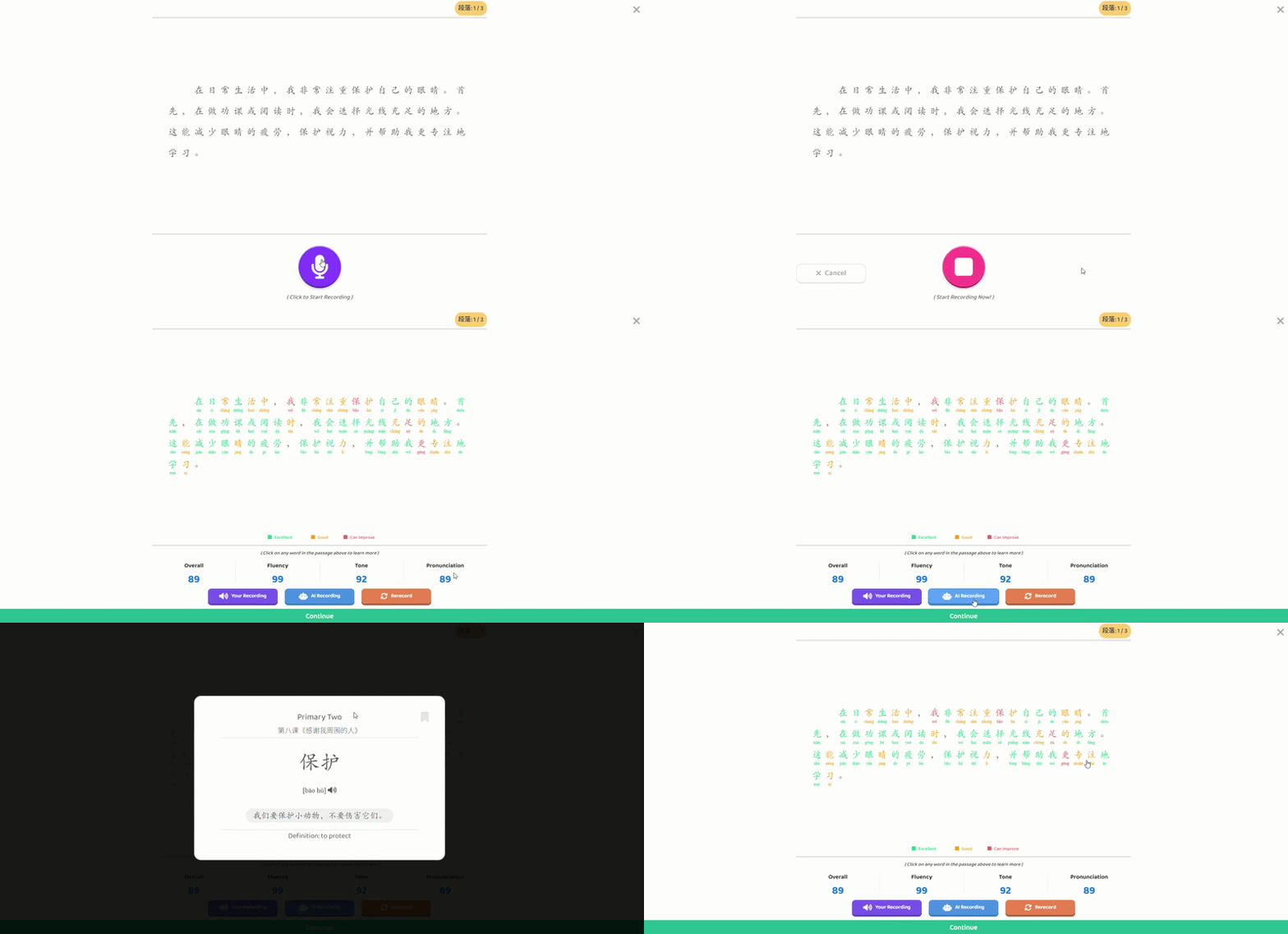
Your child can also listen to their own recording and compare it with the teacher’s recording to identify areas for improvement and build confidence through repeated practice.
3. Learn to Expand Ideas
Another common challenge is giving answers that are simply too short.
For example: 阅读很有趣,你同意吗? (PSLE 2024 Day 1)
❌ 我同意。
Although the answer isn’t wrong, it doesn’t give the examiner much to assess.
Instead, encourage your child to develop the answer.
For example:
我同意,因为……
首先……其次……最后……
例如……
总的来说……
Notice that nothing complicated has been added.
The child is simply learning to explain their thinking.
Over time, this habit helps them speak more confidently and naturally during the Oral Conversation.
A Simple Daily Routine
You don’t need two hours every evening.
In fact, shorter and more consistent practice usually produces better results.
Here’s a simple routine you can follow during Weeks 7–4.
| Time | Activity |
| 5 minutes | Review useful vocabulary |
| 5 minutes | Reading Aloud practice |
| 10 minutes | Oral Conversation practice |
If your child uses VocabKing, these activities can be supported through Reading Aloud Practice and E-Oral Practice, making it easier to practise independently while receiving immediate feedback.
Don’t Aim for Perfection Yet
At this stage, your goal isn’t to produce perfect Oral answers.
Your goal is to help your child become more comfortable thinking and speaking in Chinese.
Confidence doesn’t suddenly appear on the day of the examination.
It’s built through small, consistent practice over many weeks.
If you’ve been focusing on vocabulary, Reading Aloud and speaking regularly, you’ve already laid a strong foundation.
Now it’s time to take the next step.
Instead of simply practising more, your child needs to learn how to think like the examiner—understanding what the examiner is looking for, responding naturally, and handling follow-up questions with confidence.
That’s exactly what we’ll focus on next.
Think Like the Examiner (Weeks 3–2)
By this stage, your child should have a stronger vocabulary and feel more comfortable speaking in Chinese.
The next step isn’t learning more words.
It’s learning how to use those words naturally during the Oral examination.
Many students prepare by memorising model answers.
Unfortunately, this approach rarely works.
During the PSLE Chinese Oral Exam, examiners often ask follow-up questions based on your child’s response. If a child relies entirely on memorised answers, they may become nervous when the conversation changes direction.
Instead of memorising scripts, encourage your child to understand the question, organise their thoughts and respond naturally.
One simple framework you can practise at home is:
Point → Reason → Example
For example:
Question: 你同意学生应该参加义工活动吗?
A weak response might be:
我同意。
A stronger response would be:
我同意,因为参加义工活动可以帮助别人,也可以学习关心社会。例如,我曾经和学校一起探访老人院,陪老人聊天。我觉得这样的活动很有意义。
Notice that the child isn’t using complicated vocabulary.
They’re simply explaining their thinking clearly.
That’s exactly what examiners are looking for.
Children who can support their opinions with reasons and examples are usually able to score better during the Conversation component.
Common PSLE Chinese Oral Themes Every P6 Student Should Prepare
Although nobody can predict the exact examination topic, certain themes appear regularly because they reflect everyday life and the Primary School Chinese syllabus.
Instead of memorising model answers, spend a few minutes each day talking about these topics as a family.
Real conversations help children become more confident than simply reading model responses.
🌱 Environment
Talk about:
- Recycling
- Saving water
- Reducing waste
- Keeping public places clean
Ask questions like:
“Why is recycling important?”
“What can we do as a family to reduce waste?”
📱 Technology & Responsible Device Use
This has become an increasingly common discussion topic.
Examples include:
- Mobile phones
- Artificial Intelligence (AI)
- Social media
- Online safety
- Screen time
Encourage your child to share their own opinions instead of looking for the “correct” answer.
❤️ Community & Kindness
Discuss everyday situations such as:
- Helping elderly neighbours
- Giving up seats on public transport
- Volunteering
- Looking after younger children
- Helping classmates
Personal experiences often make answers sound more genuine and convincing.
🍎 Health & Lifestyle
Children should be comfortable talking about:
- Healthy eating
- Exercise
- Mental well-being
- Balancing study and rest
Simple everyday conversations can become great Oral practice.
👨👩👧 Family
Encourage your child to talk about:
- Helping with household chores
- Spending time with grandparents
- Looking after younger siblings
- Family outings
- Resolving disagreements respectfully
Remember, examiners aren’t looking for perfect stories.
They want to hear authentic thoughts and experiences.
Practise Like It’s the Real Examination
Around two weeks before the examination, start making Oral practice feel more realistic.
Instead of stopping every few minutes to correct mistakes, let your child complete the entire Oral practice first.
This helps them become familiar with the pace of the actual examination and builds confidence under exam conditions.
A simple mock session could look like this:
- Reading Aloud
- Oral Conversation
- Two or three follow-up questions
- Feedback and discussion
If your child is already using VocabKing, this is also a good time to increase the use of E-Oral Mock Exam Practice. Regular exposure to different question types helps children become more comfortable responding naturally rather than relying on memorised answers.
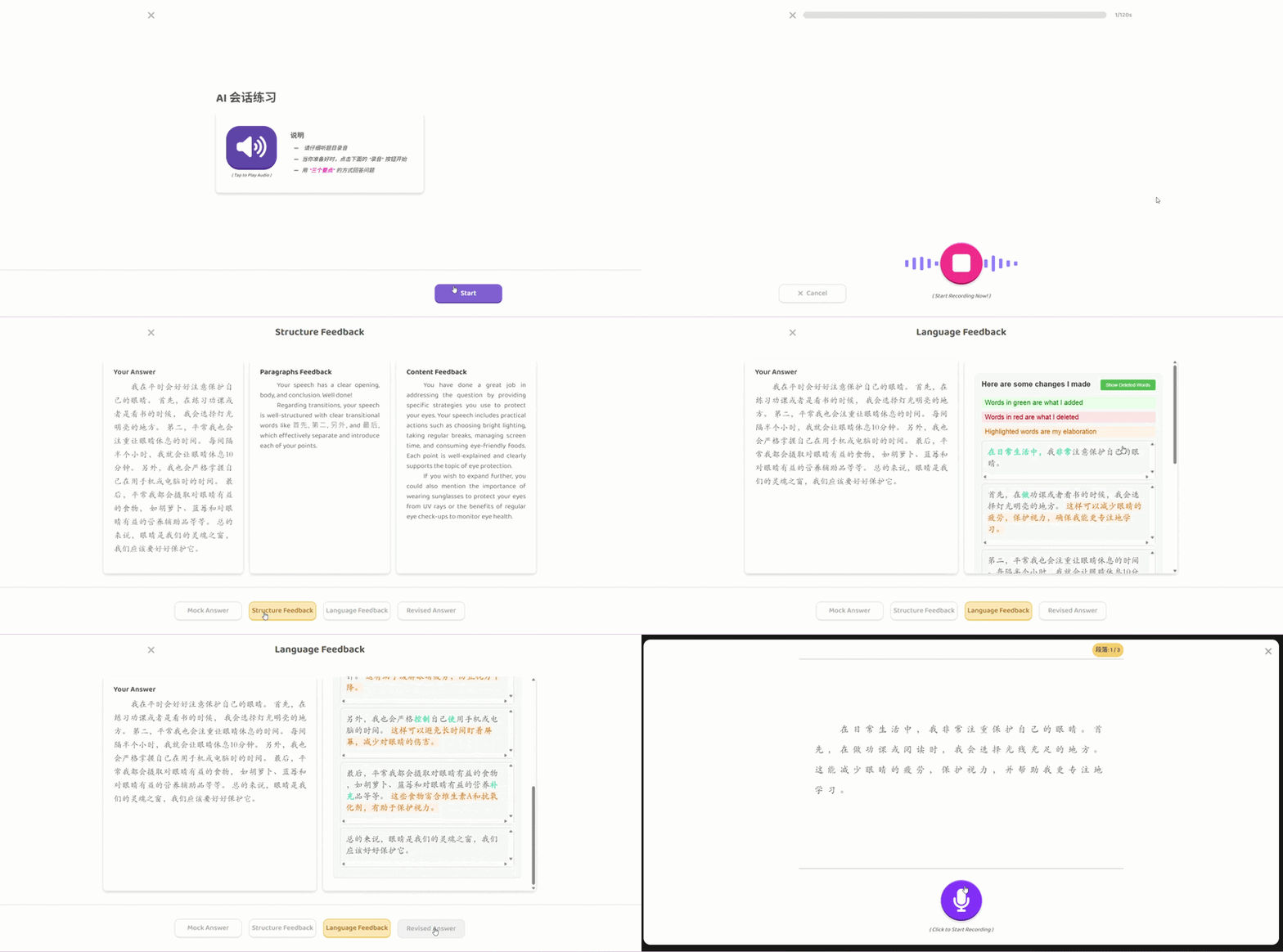
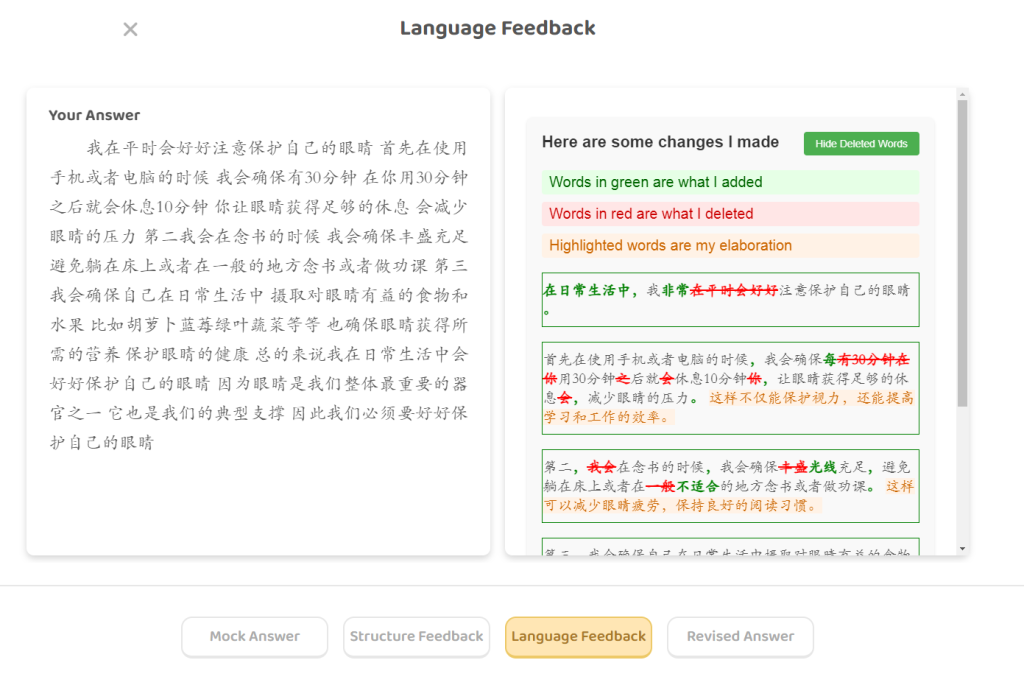
After a student submits an answer, the teacher’s model answer is displayed while the AI processes the response. Once the AI feedback is ready, the system highlights areas for improvement, such as structure and language. Students can then read aloud the revised answer to reinforce good sentence structure and build confidence.
Final Week: Build Confidence, Not Pressure
The final week before the PSLE Chinese Oral Exam often feels the most stressful for both parents and children.
By this stage, many families start searching for predicted topics or trying to squeeze in as much revision as possible.
Ironically, this is usually when children become the most anxious.
Remember, your child has already spent weeks building vocabulary, improving Reading Aloud and practising Oral Conversation. The final week isn’t about learning everything—it’s about helping your child perform at their best.
Instead of introducing lots of new vocabulary, focus on keeping your child’s confidence high.
A simple daily routine is enough:
- One Reading Aloud practice
- One Oral Conversation practice
- Review familiar vocabulary
- Listen back to previous recordings
- Get enough sleep
One mistake we often see is parents correcting every small error during the final few days.
While it’s natural to want to help, too much correction can sometimes make children lose confidence.
Instead, celebrate what your child is doing well and remind them that nobody is expected to give a perfect answer.
Examiners are looking for students who can communicate naturally—not students who memorise perfect scripts.
Final Thoughts
There are only seven weeks left before the PSLE Chinese Oral Exam 2026.
Don’t worry about being perfect.
Instead, focus on making small improvements every day.
A child who practises consistently for 15–20 minutes a day will almost always be more confident than one who crams at the last minute.
Remember, Oral isn’t about giving the “perfect” answer.
It’s about communicating clearly, expressing ideas confidently, and showing the examiner how your child thinks.
With the right preparation and a steady routine, these next seven weeks can make all the difference.
Continue the Final Stretch With Us
We know the weeks leading up to PSLE can feel overwhelming, and we want to support you every step of the way.
We’re preparing a FREE PSLE Chinese Oral Webinar this July to help parents and students prepare with greater confidence.
If you’d like early access to the webinar registration and future PSLE Oral updates, leave your details below.
Register your interest below and we’ll be the first to notify you when registration opens.
No responses yet