

Primary Six is one of the most pressuring years for students as the countdown to Primary School Leaving Examination (PSLE) begins, and many parents worry: is it too late to make a difference in my child’s Chinese grades? What if my child is very weak?
The answer is “it’s never too late.”
In fact, last year, we helped a PSLE student improve 20 marks in just 4 months without tuition. His success proves that you can make tremendous improvement as long as you revise the right way.
This guide will guide you through the key steps to help your P6 child prepare effectively and achieve your target grade for the PSLE Chinese exam. Note that this guide is primarily for normal Chinese and not Higher Chinese (HCL).
Creating a Winning Strategy
To formulate a winning strategy, we need to both understand both the PSLE exam as well as our children’s current strengths & weaknesses (知己知彼,百战百胜).
ACHIEVEMENT LEVEL (AL) SYSTEM
In 2021, the Ministry of Education (MOE) introduced a new grading system for PSLE. Instead of giving a T-score, students are now given AL from 1 (highest) to 8, and the sum of the AL for your four subjects form your overall PSLE score.
<INSERT AL GRAPHIC OF SCORE BREAKDOWN>
The key thing to note is that the bands are extremely wide at the bottom (AL5-8), while being narrow at the top (AL1-4), which is particularly disadvantageous for students that are weaker.
Wider bands means that your child needs to pull up his or her scores by a larger amount to get to the next AL.
The best example is if your child is barely passing/failing, which falls under the extremely wide AL6 band (45-64 marks). A student in the 50+ range could improve by 10 marks and not see any improvement in their overall PSLE AL score!
Pro-tip: if your child is in the AL6 range, don’t make the mistake of focusing on exam techniques prematurely. Exam techniques won’t help you improve by the 15-20 marks required to get out of the deadzone.
Conversely, a child in the 70+ range, could actually improve by 2 AL with just a few marks improvement. For instance, going from 74 to 80 (a mere 6 marks) means going from AL5 to AL3!
It sounds unfair, but that’s the way the system works. That’s why it’s so important to approach the PSLE Chinese exam with the right strategy.
Breakdown of Exam Components
There are four parts of the PSLE Chinese exam – Compo, Paper 2 (MCQ + Comprehension), Listening Comprehension and Oral, which add up to 200 marks.
Interestingly, many parents who haven’t taken a look at a PSLE paper might be surprised that only 33% of the scores are written (作文,便条,阅读理解B) as MOE has prioritised speaking over writing over the years. This changes into Secondary School but that’s a different story.
<INSERT BREAKDOWN AND DATES IMAGE HERE>
Composition – 40 marks
Students are given 50 minutes to write an essay on either a set of 5+1 pictures (看图) or a scenario (命题), and the essay is marked based on content (内容, 20 marks) and language (表达, 20 marks). In general, we recommend students to write picture essay as it’s much harder to write out of point, though HCL students might opt for scenario if they are confident.
In general, Composition is the hardest segment in PSLE Chinese to improve.
Paper 2 MCQ – 64 marks
As mentioned above, the vast majority of the PSLE paper is actually MCQ. This includes the 15 short-sentence questions, cloze-passage, and Comprehension A. While MCQ can occasionally be tricky, in general, if you can fully read and understand the question, you are likely to get it correct.
Which is why we always tell parents that the secret
In general, the MCQ components are significantly easier to score
Paper 2 – Situational Writing and Comprehension B
Listening Comprehension – 20 marks
Oral – 50 marks
Focus on Low Hanging Fruits
A common mistake many PSLE parents make is focusing too much on Compo & Comprehension B instead of low hanging fruits. For instance, we often see students who score 50-60+ marks overall attend writing enrichment class because they failed/barely passed compo, when they should instead be focused on Paper 2 & Oral.
Given that we have less than 9 months to go, PSLE Chinese is all about optimisation. Two more marks from MCQ/oral is the same as two more marks from composition, and the former is way way easier. In fact, it’s possible to achieve AL3 despite relatively weak compo/comprehension scores (see below).

Our recommendation is if you are scoring below 70+ overall, don’t spend excessive time on hard components like Compo and Comprehension B (written). Instead, focus on “low-hanging fruits” —sections that are easier to improve within a short period, such as Oral, MCQ and Listening Comprehension. After you are acing these easy sections, then focus on the harder segments.
Understanding Your Child’s Starting Point
The first step is to understand your child’s strengths and weaknesses. Review last year’s end-of-year (EOY) exam, and go through the following checklist to identify where your child’s weaknesses.

Depending on how your child is doing right now, we recommend different strategies. They key is to identify and focus on the low-hanging fruits of the exam to achieve PSLE Chinese success. We will go through each point in more detail in the rest of the post.

Next, work with your child to set achievable goals (example: review and master 100% of the P1-5 vocabulary lists by the end of March) and commit to a daily revision schedule (example: 30-45 minutes a day).
The key principle is progress over perfection. It’s about consistent improvement, not achieving 100% mastery immediately. Remember: PSLE prep is a marathon, not a sprint.
PSLE Chinese is broken down into three parts: Oral exam on 13-14 August 2025, Listening Comprehension on 16th September and Paper 1 (compo) and Paper 2 (MCQ + comprehension) on 29th September.
<INSERT SCHEDULE>
We recommend planning your preparation in the following order.
- Vocab Foundation (Jan to March): Build a solid foundation by revisiting P1-P5 material. Revise chapter by chapter in sequential order (e.g. P1 Chapter 1 -> Chapter 2) and only move on after you have achieved at least 80% proficiency.
- For each chapter, revise core words (识读字) first, then make sure you can read Go through textbooks chapter by chapter, paying attention to words, phrases, sentences, and paragraphs.
- Targeted Practice (April to June): Focus on specific areas of weakness like composition, comprehension, and oral skills. Start developing exam techniques.
- Full Exam Preparation (July to September): Concentrate on full exam preparation, including mock exams and past papers to simulate the real exam experience.
The Key to PSLE Chinese Mastery

Vocabulary is the foundation of the entire PSLE. Many students struggle due to accumulated foundational gaps in vocabulary from earlier years. The PSLE Chinese exam tests knowledge from across the primary school syllabus, specifically from P1 to P6, not just the current year’s material. Revising material from P1 to P5 ensures your child is not missing key vocabulary needed to understand exam questions and passages.
How to Build Strong Vocabulary?
Prioritize high-frequency words that often appear in exam papers rather than focusing solely on current level materials. Mastering these words can significantly improve your child’s ability to read and understand exam content. However, learning vocabulary in isolation is not enough – they need to understand how words are used in context. This means learning not just a word’s meaning, but also how it functions within phrases, sentences, and paragraphs.
Example:
保护 bǎo hù : 指尽力照顾,使自身(或他人、或其他事物)的权益不受损害。
例句:我们可以通过回收利用和减少塑料的使用来为环境保护做出贡献。
Developing active vocabulary is equally important. This involves being able to produce words when shown an image, rather than simply recognizing them. This skill is especially important for composition and oral components, where students need to actively generate language.

Source: VocabKing 会话词汇
Robust Vocabulary: Textbook Revision Strategies
The textbook is the best source for practicing vocabulary. Follow this step-by-step process:
- Start with individual characters
- Move to phrases
- Progress to sentences
- Study complete paragraphs
- Practice reading aloud
This systematic approach ensures a broader understanding and tests vocabulary comprehension.
Important tips:
- Once you learn a word, find it in the textbook and read the entire sentence for context.
- Complete a thorough revision of each textbook chapter before moving to the next, ensuring that vocabulary from previous chapters is properly reviewed.
- Always read aloud rather than silently, as students tend to skip words they don’t recognize during silent reading subconsciously.
For children with a weak foundation, start revision from P1 or P3 textbooks and work upwards level by level. This builds confidence as the material will be more manageable.
Oral – The Make-or-Break Factor
Oral makes up 25% of the total PSLE Chinese exam score. This substantial weightage means that a strong oral performance can significantly boost a student’s overall grade. Oral is considered the easiest aspect of the PSLE Chinese exam to improve, provided students practice consistently.

Students should aim for specific minimum scores in oral, depending on their target grade
There’s a growing trend toward unpredictable and unscripted oral questions, requiring students to be adaptable and able to respond to a variety of topics, rather than relying solely on memorized templates. This means students need to be comfortable speaking about different subjects, even those they haven’t specifically prepared for.

PSLE Chinese Oral Exam Topic from 2020-2024
Earlier Preparation for Chinese Oral
As we know, there is a change in the PSLE English oral weightage from 30 marks to 40 marks. This emphasizes why last-minute cramming is not ideal for Chinese oral preparation, as you’ll have limited time to practice.
Importance of Daily Practice

Daily revision is crucial because cramming is ineffective. Short, daily sessions are more effective than long, infrequent ones because they are more manageable and maintain focus. For instance, dedicating 10 to 15 minutes every day to practicing Chinese is better than spending an hour on a Sunday. This consistent exposure to the language and material makes it easier to retain information and build skills.
Daily oral practice is essential for developing fluency, confidence, and good articulation. This can involve speaking, reading aloud, and practicing responses to different types of questions.
Actionable Information for Parents
To effectively support your child’s PSLE Chinese preparation, consider the following strategies:
- Assess Your Child’s Current Level: Begin by determining your child’s current proficiency using past exam papers. A detailed score breakdown (ideally in a spreadsheet format) can pinpoint specific strengths and weaknesses, providing a clear starting point. Engage with your child’s Chinese teachers or tutors to discuss specific concerns and develop effective learning strategies.
- Set Realistic Goals: Collaborate with your child to establish achievable goals with a realistic timeline.
- Prioritize Vocabulary Development: Building a strong vocabulary foundation is crucial. Focus on high-frequency words and active vocabulary acquisition using textbook review methods.
- Focus on Areas for Quick Improvement: Prioritize areas where improvement can be achieved relatively easily, such as vocabulary and oral skills, before tackling more complex areas like composition. As one expert suggests, focusing on “low-hanging fruit” can yield faster results.
- Implement Daily Practice: Encourage daily practice of speaking, reading, and vocabulary.
- Utilize Spaced Repetition: Implement a spaced repetition revision strategy to optimize vocabulary retention. This technique is widely recognized as a highly effective method for language learning.
- Start Oral Practice Early: Early and consistent oral practice is essential. Practice a variety of oral topics, including those that require spontaneous responses, not just memorized answers.
And last, consider supplemental support to empower your child’s PSLE Chinese journey.

The PSLE is a major milestone, and as a parent, you want to give your child every advantage. We understand the time and effort you invest in their success, and we also recognize the challenges of balancing busy schedules with effective PSLE preparation. That’s why we developed VocabKing.
VocabKing makes daily Chinese practice engaging and accessible through interactive exercises and games aligned with the MOE syllabus. We’ve identified high-frequency words from top school papers, ensuring your child focuses on the most relevant vocabulary.

Source: VocabKing Textbook Revision

Source: VocabKing High Frequency Word
To help native English speakers build confidence in spoken Chinese, VocabKing has introduced an innovative AI voice chatbot. This allows children to practice speaking outside the classroom, discussing engaging topics in a judgment-free environment. This encourages them to articulate their thoughts, build fluency, and gain the confidence they need for oral exams.

Source: VocabKing AI Voice Chatbot
Beyond vocabulary and conversational practice, VocabKing also offers the first and only free-response oral practice in Singapore that simulates the actual PSLE exam. This feature provides invaluable experience and helps your child feel prepared and confident on exam day. To further motivate consistent practice, a built-in reward system keeps students engaged and excited to learn.
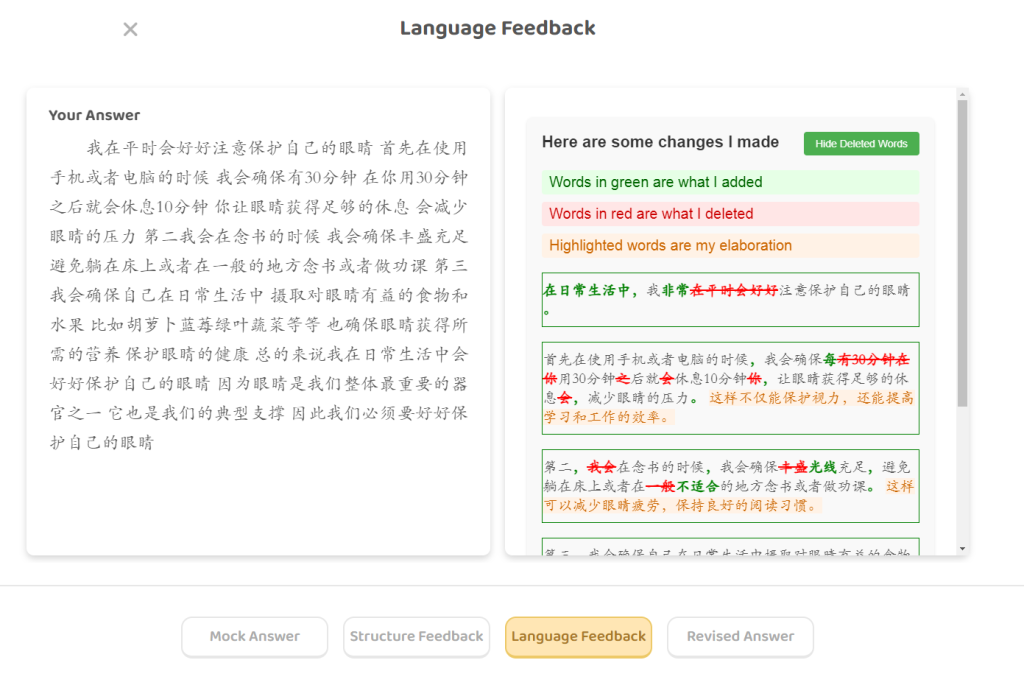
Source: VocabKing Free Response Practice with AI
See the difference VocabKing can make. We now offer a 7-day FREE trial. Try it today and help them make PSLE Chinese a success in their academic journey. Sign up your free trial account here: https://learn.vocabking.com.sg/login or contact us at +65 9820 7272 for more information!
Final Thoughts
The countdown to the PSLE has begun, but it’s never too late to make a difference. By implementing these structured strategies, emphasizing consistent practice, and utilizing resources like VocabKing, your child can achieve significant progress. Remember, success is not about perfection; it’s about steady improvement. Start today and help your child unlock their full potential!
P.S. We discussed this in detail during our recent webinar. If you missed it and would like to learn more, join our parents’ group for free access to the recording.
No responses yet