
I recently received a message from a P6 parent asking what she should do after her child failed Prelims. This post is a quick guide for VocabKing subscribers on how to use a 3-step method to rapidly improve vocab in 30 days.
Before we dive in, I want to reassure you that prelim grades aren’t a guaranteed prediction of your child’s PSLE score. Over the years, I’ve seen many students make remarkable improvements between prelims and the actual exam.
The key is this: don’t be resigned to the result. Do something about it over the next month.
Understanding The Real Challenge
Let’s be honest – if your child is in the 45-50+ range, minor improvements like memorising a few compo openings won’t cut it. This is because the AL6 (45 to 64 marks) band is too wide, and you need structural, significant improvements to break out.
Like this P6 parent who went from 45 to 75 in a few months using the 3-step method.

Here’s what many parents don’t realise about PSLE Chinese:
It’s not just testing P6 content. For instance, in Paper 2 (the paper that is 45% of the score, covering MCQ and comprehension), the answers and choices are largely from P4-P6. In addition, 90% of the Comprehension passages come from lower primary – thus, even if they aren’t the answer, if a student has forgotten too many lower primary words, it affects their ability to deeply understand the passage and drags them down marks-wise.
Remember: unlike Math or Science, there aren’t that many “trick” questions for PSLE Chinese Paper 2. If you can read every word in the question, you most likely can get it correct.
Thus, the core solution is to help your child improve their vocabulary as much as possible over the next month.
3-Step Method to Boost Your Child’s Chinese Vocabulary Fast
Step 1: Master High-Frequency Words (3-4 hours)
Start with the 600+ high-frequency words from P1-P6. Why? These words are quite easy yet cover about 70% of PSLE Paper 2.
But note, not all frequency lists are built the same. Conventional standard frequency lists are based on native materials like Chinese newspapers, blogposts, etc and are nice to know BUT not very practical when you only have one month til exam day.
At VocabKing, our frequency list is based on the MOE curriculum, and we used AI to analyse over 200 PSLE, Prelim, and other exam papers to identify what words consistently appear. That’s why you’ll find terms like 民众俱乐部 and 日期, which appear in almost every 便条
To revise this, go to High Frequency words in VocabKing, and you want to complete every single exercise starting from P1 and moving to P6. High-frequency words are by definition quite simple, but you don’t want to skip this step.

Step 2: Systematic P4-P6 Vocabulary Revision
Mastering P4-P6 core vocab (识读字) is the core priority, as this is where most Paper 2 answers come from. It’s important to track your child’s vocab progression, and you can click on Analytics -> Vocab Proficiency to get a real-time update. You want all P4-P6 vocab to be in the Learning/Proficiency/Mastered columns by PSLE.

You have two options:
Option A: For Stronger Students (3-5 days)
This option is for students who don’t have trouble understanding sentences, and just need a quick review of the words.
I recommend systematically reviewing your 词语手册 or using VocabKing’s vocab exercises that are grouped by chapter. You want to go through every chapter from P4 to P6. One quick tip is to use VocabKing’s Exam mode revision, where you will only be tested on words that are unknown or unseen, while skipping words you already know.

Also, make sure you are practising collocations or 词语搭配, which are word chunks that appear together like 增添气氛. Depending on the year, this can contribute up to 10 marks in Paper 2, and also helps reinforce understanding of the underlying words.
We found that certain collocations appear quite frequently in exams, like 上网搜索资料 or 克服困难, and we collated the list of the most common collocations in our Tree Game. Be sure to go through them!

Option B: For Students Needing More Support (7-10 days)
This option takes more time, but is very suitable for students who understand individual words but struggle when they appear in sentences. This often stems from vocabulary gaps in earlier levels, and pulls down students in cloze passages and comprehension.
Introducing Mastery Mode, our latest tool to help students rebuild their vocab foundation from the ground up. We piloted this last year using a manual approach and found it extremely useful for students who have weaker foundations, as it systematically rebuilds knowledge gaps.
Firstly, select the level you want to practice. I highly recommend starting from an easy level (e.g. P4 -> P5 -> P6) rather than your child’s current level. For most ideal results, we would actually start from P1, but given lack of time, we can start from P4.
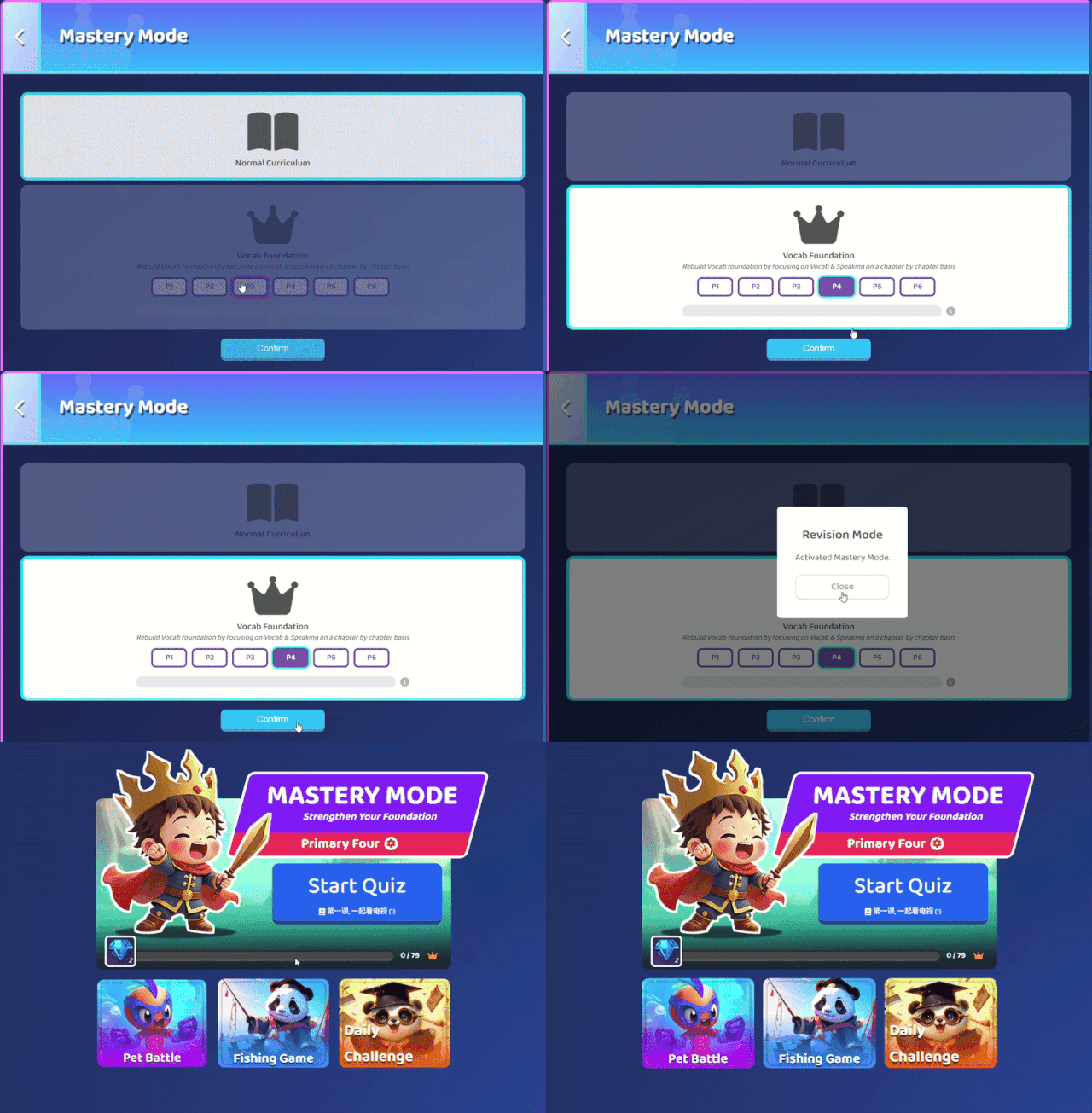
The system will then start from Chapter 1 of your selected level, and for each chapter, your child will need to master the core vocabulary, and then read aloud sentences using this vocabulary to build up an understanding of how it is used within a sentence. Note: even though oral exams are over, we still highly advocate for reading aloud over silent reading as this dramatically helps vocab retention through the production effect.
Importantly, the sentences utilise vocabulary from previous levels and chapters, so each time you read aloud a sentence, you are actively revising older material.
To use a fake example, imagine a child learnt “我爱我的妈妈” in Chapter 1. In Chapter 2, we learn 爸爸, and practise “我爱我的妈妈和爸爸”. This sentence revises both the new word 爸爸, but also reinforces the vocab taught in Chapter 1.
This constant layering is critical for helping students improve quickly.
Step 3: Holistic Revision Through Read-Aloud Practice
Finally, reading a whole passage aloud is one of the fastest ways to recap vocabulary and prepare for comprehension.
Remember not to silently read, but to read it aloud. I highly recommend using our Custom Materials tool, where you can snap a picture of any text, practise reading and get AI feedback. In addition, you can click on any unknown word to see its meaning and save it to word list for quick revision.

Here’s the priority order:
1. Textbook passages – Focus on 我爱阅读 (核心) from each chapter. This gives the best return on investment and should be done by ALL students.

2. Past PSLE papers – Practice reading the last 2-3 years of PSLE 阅读理解B组.
3. Model compositions – Kill two birds with one stone by reading model essays daily. Note that compositions often contain out-of-syllabus vocabulary, so plan accordingly.
Final Thoughts
We’ve successfully used the aforementioned 3-step method to help many students over the last year, and hopefully it works for you.
With just a few weeks left before PSLE, every day counts. Start with Step 1 today – it only takes a few hours and covers 70% of the paper. Then move systematically through the remaining steps based on your child’s needs.
Your child’s prelim result doesn’t define their potential. With focused effort and the right strategy, significant improvement is absolutely possible! Good luck!
Want to put this 3-step method into action right away? Start VocabKing Free 7-day Trial now: https://learn.vocabking.com.sg/login or WhatsApp us at +65 8064 8461 for more info.
No responses yet